Research • Prompts • High Accuracy
High-Accuracy AI Research Prompt Pack for Perplexity
If your research needs to be trustworthy, the prompt matters more than the model. This pack forces better sources, clearer assumptions,
and cleaner outputs—without sounding robotic or vague.
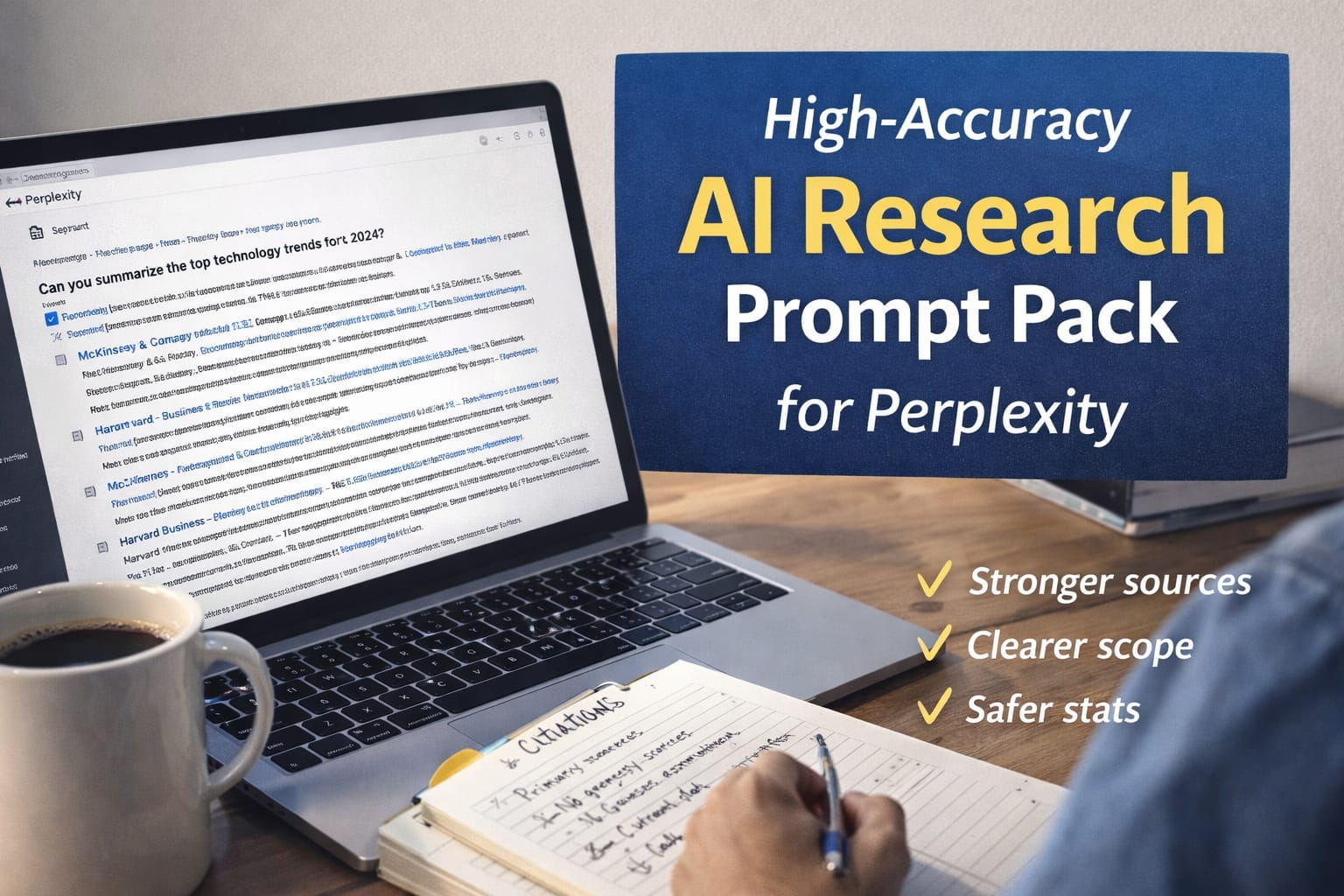
AI research becomes unreliable for one simple reason: people ask for “answers” instead of asking for “evidence.”
When you push Perplexity to behave like a careful analyst—cite sources, show uncertainty, and separate facts from assumptions—
the quality improves immediately.
Decide the timeframe (example: 2024–2026), the region (global / US / India), and the output format (short summary / table / steps).
Then add one rule: “Cite sources for every important claim.”
The prompt pack (copy-paste)
Replace the placeholders like [TOPIC] and [TIMEFRAME]. Keep your prompt strict and specific.
That’s what produces “high accuracy” in real life.
1) Source-first answer (prevents weak citations)
Research: [TOPIC].
Give a concise answer using reliable sources only.
Cite sources for every key claim.
If sources disagree, show both views and explain why.
If evidence is weak, say “uncertain” instead of guessing.
2) Fact-check a specific claim (fast verification)
Verify this claim: “[CLAIM]”.
Return:
1) Verdict: true / false / mixed
2) Best supporting sources (with citations)
3) What people commonly misunderstand
4) What would change the verdict (missing data)
3) Compare options objectively (no marketing tone)
Compare [OPTION A] vs [OPTION B] for [USE CASE] in [REGION].
Give a short table: strengths, limitations, best-fit users, and risks.
Cite sources for any non-obvious or changing details.
4) Extract numbers safely (stops made-up stats)
Collect credible statistics for [TOPIC] in [TIMEFRAME].
For each number include: value, year, region, and citation.
If a reliable number isn’t available, say “not found” and suggest where to verify.
5) Latest updates only (time-bounded research)
Find the most important updates on [TOPIC] from the last [X months/years].
Summarize what changed, why it matters, and who it affects.
Include dates + citations for each update.
6) Publish-ready summary (human tone + accurate)
Write a 350–550 word article-style summary of [TOPIC] for [AUDIENCE].
Tone: human, professional, clear. Avoid robotic filler.
Include citations for major claims.
End with a simple “what to do next” paragraph.
7) Second-pass verification (high-accuracy filter)
Re-check your previous answer for accuracy.
List any statements that are not directly supported by sources.
Replace or remove them.
Return the corrected version with citations.
The accuracy routine (2 minutes)
After you get the first answer, don’t trust it blindly. Open the top 2–3 sources and confirm the most important lines.
Then run the “Second-pass verification” prompt. This catches the common failure mode: statements that sound right but aren’t fully supported.
Add your constraints directly in the prompt: “Use only primary sources,” “Focus on India,” or “Only include studies after 2023.”
Perplexity becomes sharper when you reduce the search space.